
If you’re craving a road trip with skyline views, crashing waves, coastal hikes, and fresh seafood, this drive from New York City to Nova Scotia delivers.
In just over 800 miles, you’ll go from flashing billboards and skyscrapers to quiet fishing villages, towering sea cliffs, and some of the highest tides on the planet.
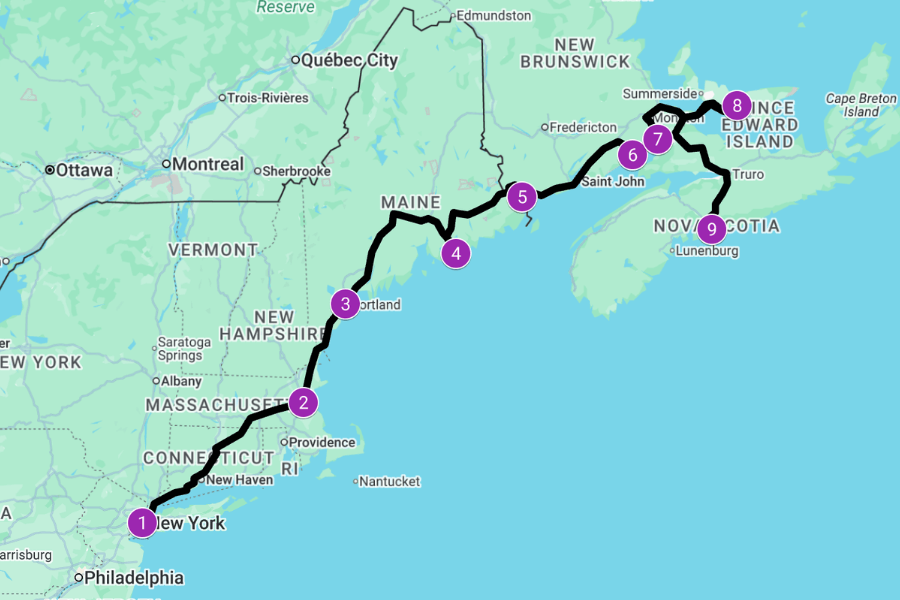
Along the way, you’ll cross international borders, drive over a very long bridge, stand on the ocean floor, and see towering rock formations.
This itinerary breaks down exactly where to stop, what to see, and the can’t-miss experiences that turn a simple road trip into an unforgettable coastal adventure.
1. New York City, New York

We’re starting this road trip in New York City, the perfect place to start before trading skyline views for open highway.
From the bright lights of Times Square to the calm paths of Central Park, the city packs an unforgettable sendoff.
2. Boston, Massachusetts

Leave the nonstop buzz of New York City and drive 3.5 hours to Boston, perched on the shores of Massachusetts Bay.
Founded in 1630, this city is one of the oldest in the U.S., and you can walk through its history along the 2.5-mile Freedom Trail that connects 16 sites.
Among them are Paul Revere’s House, the Old North Church, and the USS Constitution, the world’s oldest commissioned warship still afloat.
For a change of pace, swing by Fenway Park, opened in 1912, home of the Red Sox and its famous 37-foot-tall Green Monster.
If you can’t catch a game, you can still tour the stadium on non-game days.
You can also unwind at Boston Common, the country’s oldest public park, which makes this stop feel both historic and walkable.
3. Portland, Maine

After exploring Boston’s brick-lined streets, continue for 1 hour and 45 minutes to reach Portland, Maine, a coastal city set along Casco Bay.
It’s famous for its working waterfront in the Old Port, where lobster boats unload their daily catch along the harbor.
From there, cobblestone streets lead you past 19th-century brick warehouses and into spots like Old Port Sea Grill for fresh fish and oysters.
You can also hop on a ferry to Peaks Island for a scenic 3.9-mile bike loop with ocean views or stay and wander through local boutiques, breweries, and cafés.
4. Acadia National Park, Maine

Up next is Acadia National Park, most of which lies on Mount Desert Island, where the road winds past granite peaks and thick pine forests.
Covering 49,000+ acres, the park is home to Cadillac Mountain, which rises 1,530 feet and is one of the first places in the U.S. to see the sunrise for much of the year.
Here, you can hike the 3.3-mile Jordan Pond Path for peaceful water views with the “Bubbles” in the background, or tackle the Beehive Loop with its iron rungs.
If you would rather explore by car, Park Loop Road stretches 27 miles and passes the famous Thunder Hole, where waves crash into a narrow inlet and boom like a cannon.
5. St. Andrews-by-the-Sea, New Brunswick

Now drive 2 hours and 45 minutes, crossing into Canada to reach St. Andrews-by-the-Sea, a charming coastal town on Passamaquoddy Bay in New Brunswick.
It’s known for the Bay of Fundy’s extreme tides, which can swing up to 30 feet, completely changing the shoreline and exposing wide stretches of ocean floor that you can walk on.
There’s more to discover here, from Kingsbrae Garden’s 27 acres of themed spaces to whale watching tours and the historic Algonquin Resort, which opened in 1889.
And if you make your way to Water Street, you’ll pass colorful wooden buildings that are home to boutique stores, ice cream shops, and local restaurants that round out this charming coastal town.
6. Fundy National Park, New Brunswick

From St. Andrews-by-the-Sea, it’s a 2-hour and 20-minute drive to Fundy National Park, where thick forests and dramatic cliffs shape the scenery.
This 80-square-mile park is famous for its towering tides, with about 100 billion tons of water flowing in and out of the Bay of Fundy during each tidal cycle.
When you’re ready to explore, hike the 0.9-mile Dickson Falls trail to a scenic waterfall or challenge yourself on the 25-mile Fundy Footpath.
If you time your visit for low tide, swing by Herring Cove Beach and walk out along the shoreline toward the rocky headland.
7. Hopewell Rocks Provincial Park, New Brunswick

After leaving Fundy National Park, continue for 35 minutes to Hopewell Rocks Provincial Park, where the Bay of Fundy puts on one of its most jaw-dropping displays.
Here, the tides have carved massive flowerpot-shaped rock formations that stand as high as 70 feet.
For the best view, visit at low tide to walk on the ocean floor beside these towering pillars, then return at high tide to kayak around them in deep water.
The main access point is a 101-step staircase down to the beach, which feels like a big shift from the wooded hikes earlier.
(Please note that Hopewell Rocks Provincial Park is seasonal, typically open from mid-May through October, with services available during those months.)
8. Charlottetown, Prince Edward Island
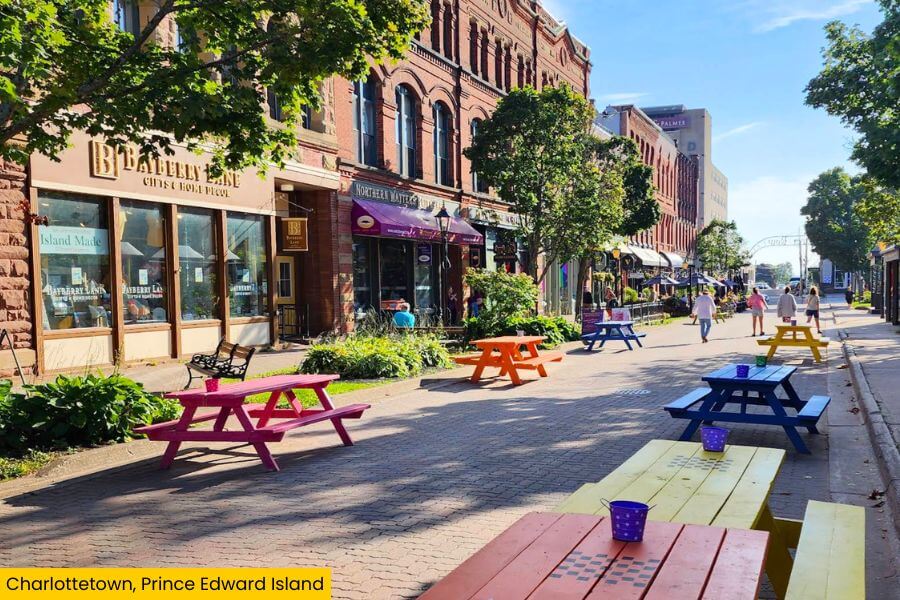
Then make your way to Charlottetown, the capital of Prince Edward Island, by driving across the 8-mile Confederation Bridge over the Northumberland Strait.
It’s nicknamed the Birthplace of Confederation thanks to the 1864 Charlottetown Conference, held mostly at Province House with events at Government House.
History aside, you can explore at your own pace, especially on Victoria Row, which turns pedestrian-only in the summer with shops and restaurants lining the street.
You can also swing by the Charlottetown Boardwalk and soak up the salty air and open views across the water.
9. Halifax, Nova Scotia

Last but not least is Halifax, about 3.5 hours from Charlottetown, the lively waterfront capital of Nova Scotia, set on one of the world’s largest natural harbors.
This is Halifax Harbour, and you can follow the boardwalk for about 2.5 miles and pop into the Maritime Museum of the Atlantic to see Titanic artifacts.
High above the city sits the Halifax Citadel National Historic Site, a star-shaped fort built in 1856, where you can step back into military life from May through October.
To round it all out, you can dine at The Bicycle Thief, sip a pint at Alexander Keith’s Brewery, and watch fishing boats glide across the harbor for a grand finale.
Related Posts