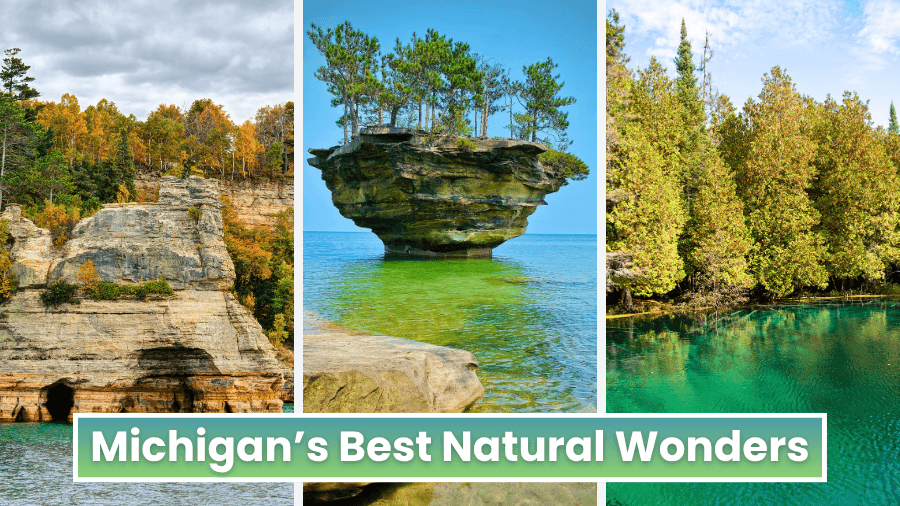
Michigan is packed with wild places that don’t feel anything like the Midwest you might expect.
You’ll find cliffs that glow with streaks of color, dunes that tower above bright blue water, and hidden spots where the water is so clear you can see straight to the bottom.

Some of these places are adventures in themselves to reach, while others are just a short stroll from the parking lot but every single one offers an experience you won’t forget.
If you’re ready for quiet forests and views that will make you stop in your tracks, these nine natural wonders are absolutely worth adding to your list.
1. Pictured Rocks National Lakeshore

Pictured Rocks National Lakeshore sits along a 42-mile stretch of Lake Superior in Michigan’s Upper Peninsula, between the towns of Munising and Grand Marais.
It’s famous for its towering sandstone cliffs that rise up to 200 feet above the water, streaked with bold colors like red, orange, and green caused by minerals like iron and copper seeping through the rock.

You can hike to spots like Miners Castle and Chapel Rock, paddle past the cliffs by kayak, or check out waterfalls like Spray Falls dropping 70 feet straight into the lake.
This place became the first National Lakeshore in the United States in 1966, and if you visit in winter, the shoreline turns into a frozen wonderland with massive ice caves and thick curtains of ice clinging to the cliffs.
2. Sleeping Bear Dunes National Lakeshore

Sleeping Bear Dunes National Lakeshore stretches for 35 miles along Lake Michigan’s eastern shore near Traverse City, and it’s home to massive sand dunes that tower up to 450 feet above the water.
The star of the show is the Dune Climb, where you can power up a steep sandy slope, catch your first views of Lake Michigan, and continue about 1.75 miles across the dunes all the way to the shoreline.

For jaw-dropping views without the leg workout, drive the Pierce Stocking Scenic Drive, a 7.4-mile loop with overlooks where you can stand on a bluff and look straight down at the bright blue lake below.
This area also includes the Manitou Islands just offshore, and local legend says the dunes were formed when a mother bear and her two cubs tried to cross the lake, giving the park its unforgettable name.
3. Tahquamenon Falls State Park
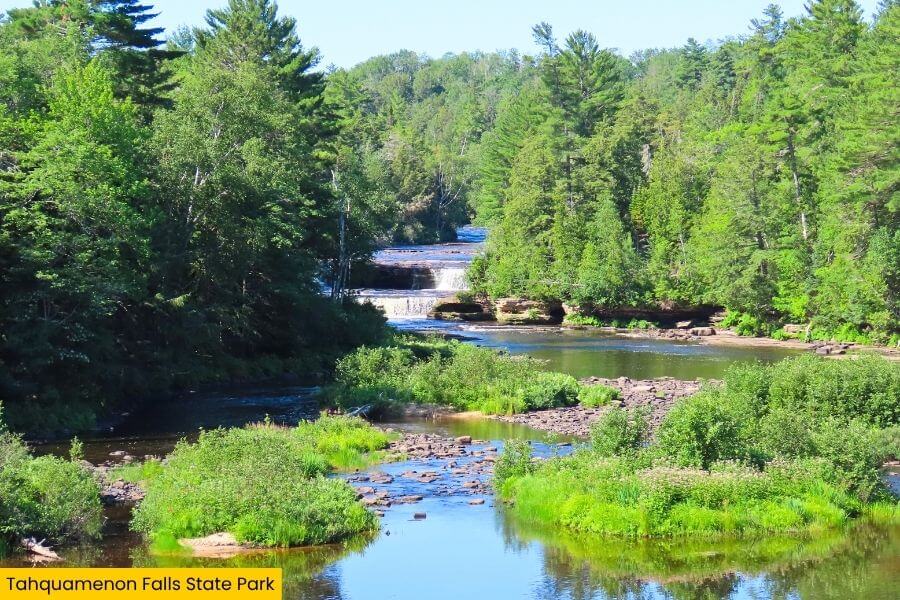
Next up is Tahquamenon Falls State Park in Michigan’s Upper Peninsula near Paradise, where Tahquamenon Falls steal the spotlight with one of the largest waterfalls east of the Mississippi.
The Upper Falls drop nearly 50 feet and stretch more than 200 feet wide, sending up to 50,000 gallons of water per second crashing into a deep, foamy pool that often glows a tea-brown color from natural tannins in the cedar swamps upstream.

A few miles downstream, the Lower Falls split into a series of smaller cascades around an island you can reach by rowboat, making it easy to explore different viewpoints up close.
You’ll find over 35 miles of hiking trails winding through thick forest, plus a year-round brewery right inside the park where you can grab a cold drink after checking out one of Michigan’s most powerful waterfalls.
4. Isle Royale National Park

Then things get a little more off-the-grid with Isle Royale National Park, a remote island park sitting out in Lake Superior off Michigan’s Upper Peninsula.
You can only get here by ferry or seaplane, and once you arrive, there are no roads at all, just over 165 miles of hiking trails winding through thick forest, rocky ridges, and quiet inland lakes.
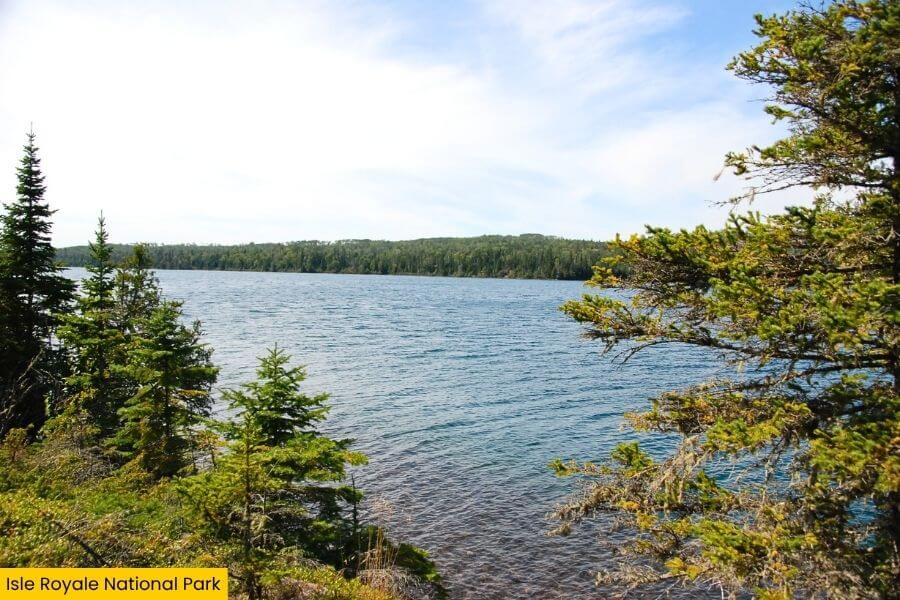
The island is famous for its long-running wolf and moose study, one of the oldest wildlife research projects in the world, and you might spot moose wading in shallow water or hear wolves howling at night.
With over 400 smaller surrounding islands, crystal-clear water, and some of the darkest night skies in the Midwest, this place feels wild, quiet and completely cut off.
5. Porcupine Mountains Wilderness State Park

Porcupine Mountains Wilderness State Park sits in Michigan’s western Upper Peninsula, a massive 60,000-acre park along the south shore of Lake Superior.
This place is all about old-growth forest, with towering sugar maples and hemlocks that are over 300 years old, plus more than 90 miles of hiking trails to explore.
One of the best spots is Lake of the Clouds, a lake tucked between ridges, where a short, easy walk leads to a lookout with one of the most photographed views in the Midwest.
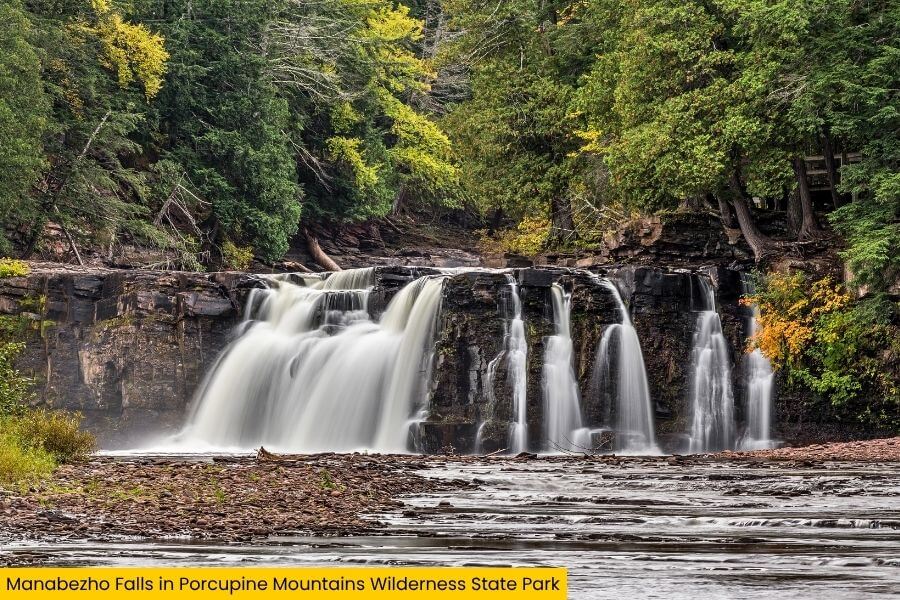
You can also hike to waterfalls like Manabezho Falls and Manido Falls on the Presque Isle River, where fast-moving water crashes over wide rock shelves.
6. Kitch-iti-kipi

Kitch-iti-kipi is a freshwater spring located inside Palms Book State Park near Manistique that looks straight-up unreal the second you see it.
This spring pumps out about 10,000 gallons of water per minute and stays a constant 45 degrees year-round, creating a crystal-clear pool that’s over 200 feet across and about 40 feet deep.

You can hop on a self-operated raft that pulls you across the water, letting you look straight down at ancient tree trunks, limestone formations, and giant trout gliding through the bright turquoise water.
The name means “Big Cold Spring” in Ojibwe, and once you see those bubbling sand boils shifting on the bottom, it’s easy to see why this spot feels totally different from anywhere else in Michigan.
7. Arch Rock

Mackinac Island is home to Arch Rock, one of Michigan’s most famous natural landmarks perched 146 feet above the shoreline of Lake Huron.
This massive limestone arch stretches about 50 feet wide and was carved out by waves thousands of years ago back when water levels were much higher.

You can reach it by climbing 207 steps from Lake Shore Drive or by biking the island’s 8.2-mile perimeter road and stopping at the scenic overlook above.
From the top, you get a wide-open view of Lake Huron’s bright blue water and passing boats, plus a perfect angle to snap photos of this unique rock formation that looks like a giant stone bridge frozen in time.
8. Silver Lake Sand Dunes

Trade rocky overlooks for rolling hills of sand at Silver Lake Sand Dunes, located along Lake Michigan near the town of Mears on the western side of the Lower Peninsula.
This 450-acre dune system lets you drive right onto the sand, and you’ll see everything from dune buggies to jeeps cruising up and down steep slopes that can rise around 200 feet.
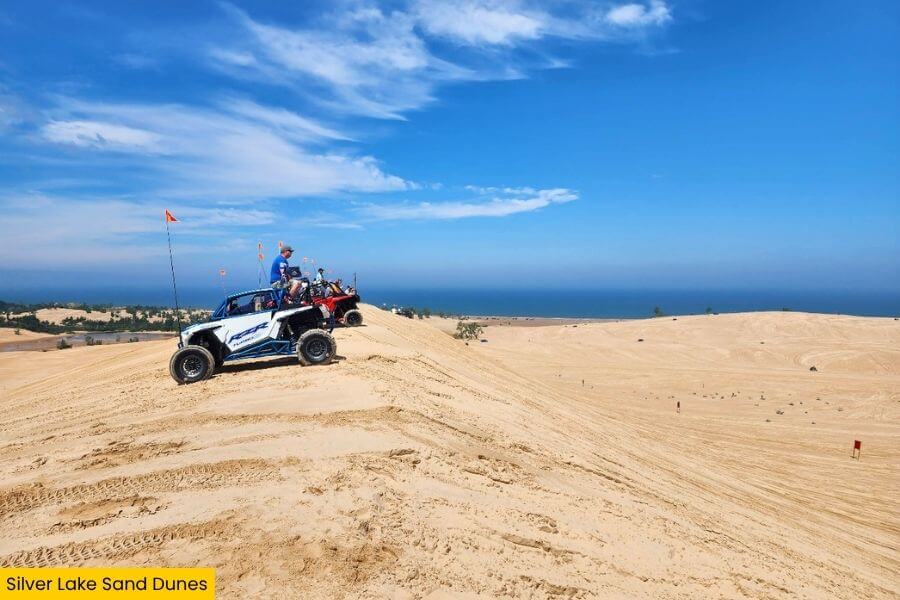
If you’d rather take it slow, hike the trails or climb to the top for sweeping views of Silver Lake on one side and Lake Michigan on the other.
There’s also a pedestrian-access dune climb near the Little Sable Point Lighthouse, where you can kick off your shoes, dig your toes into the sand, and watch the sun drop straight into the lake.
9. Turnip Rock

Turnip Rock is a quirky rock formation sitting just offshore in Lake Huron near Port Austin at the tip of Michigan’s Thumb.
This narrow stack of limestone looks like a giant turnip, with a thin base and a wider top covered in grass and small trees, shaped over thousands of years by constant wave erosion.

You can’t drive to it, so the only way to see it up close is by kayaking from Port Austin State Harbor, passing cliffs, small sea caves, and other unique rock formations along the way.
The bright blue water, smooth white rock, and unusual shape make this one of the most photographed spots in the area, and paddling out to it feels like a mini adventure all on its own.
Related Posts