There’s something seriously spooky about an abandoned town in the middle of the woods.
Remains of old buildings. Rusty metal left behind. Trails that lead to nowhere. And the only way to get there? On foot.
Hidden deep in the Washington mountains, there’s a ghost town that once boomed with gold mines, trains, and dreams of striking it rich.
Now it’s quiet. Still. Creepy in the best way.
You won’t find crowds here. No roads. No cell service. Just miles of forest, a muddy trail, and the feeling that you’ve stepped into another time.
If you’re up for a little adventure with some ghost town mystery, keep reading. This place is real, and you can totally hike there.
Where Is It?

Monte Cristo is tucked away in the Cascade Mountains in Snohomish County, Washington.
The hike begins at Barlow Pass Trailhead.
If you’re coming from Seattle, it’s about a 1.5‑hour drive to Barlow Pass Trailhead and just over an hour from Everett.
You’ll head toward Barlow Pass along the Mountain Loop Highway, then lace up your boots because the last stretch to Monte Cristo is only accessible by foot.
About

Monte Cristo is one of those rare places that feels frozen in time, and not in a cheesy haunted house way.
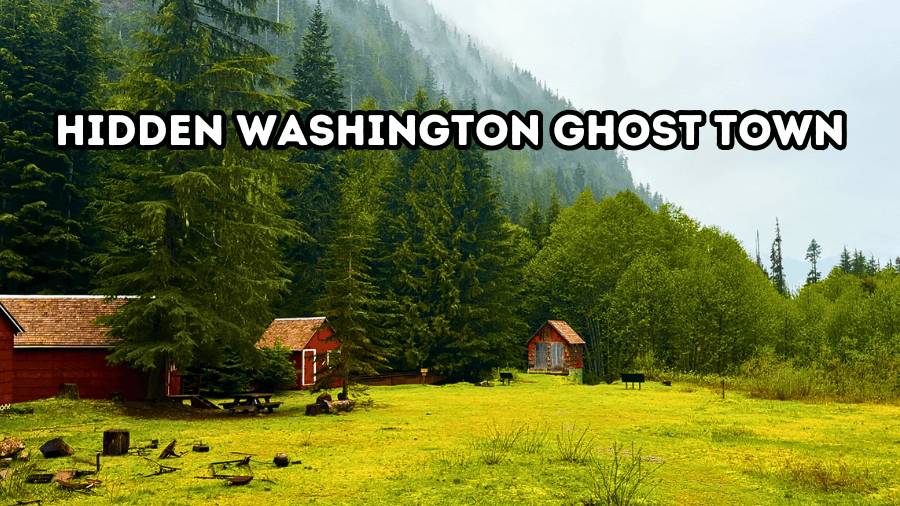
We’re talking rusted mining equipment scattered in the grass, decaying wooden buildings hiding in the trees, and quiet mountain views that are seriously jaw-dropping.
This ghost town sits deep in the North Cascades, and the only way to get there is by hiking the old road from Barlow Pass, a roughly 4-mile one-way (8-mile roundtrip) route.
It’s not a tough trek, but be ready for a few stream crossings, mud, and lots of moss-covered everything.
You’ll follow the old Monte Cristo Road, which got wiped out by floods years ago and was never repaired.

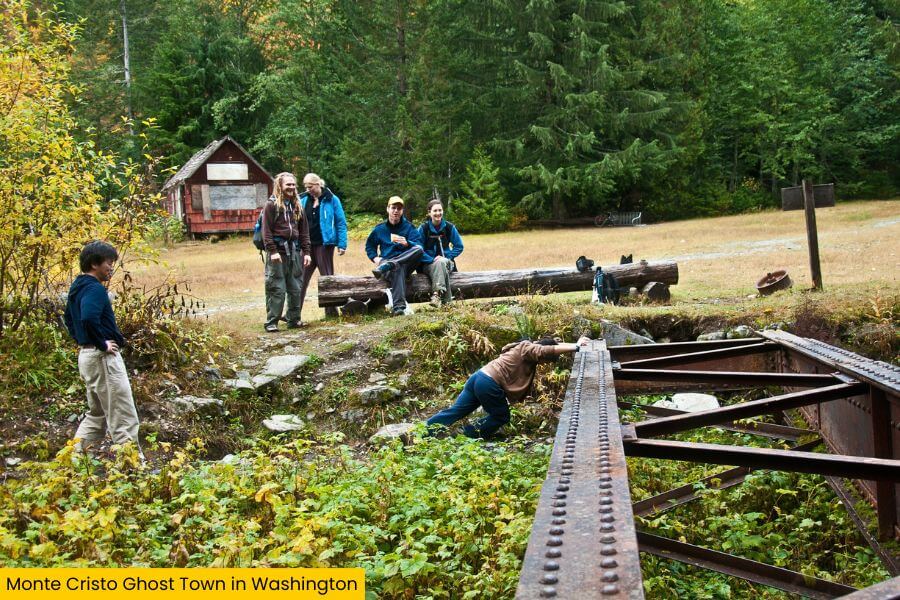
Once you reach the townsite, you’ll find the remains of old buildings, a rusting turntable, scattered mining relics, and a few interpretive signs to help you picture what life used to look like here.
The whole area feels like a forgotten movie set. Quiet, eerie, and totally fascinating.
And the best part is that you’re surrounded by jaw-dropping scenery the whole way. Towering peaks, thick forests, and the sound of the river rushing nearby.
If you’re into off-the-beaten-path adventures, then Monte Cristo is 100% worth the hike.
History

Monte Cristo wasn’t always a quiet, crumbling ghost town tucked in the mountains.
Back in the 1890s, this place was buzzing with life, thanks to a silver and gold mining boom that turned it into one of Washington’s busiest mining towns almost overnight.
Miners flooded in chasing big dreams, and at its peak, Monte Cristo had around 1,000 residents.
There were hotels, saloons, a post office, homes, and even a railroad that connected the town to Everett.
Yep, they actually built a railroad through the mountains just to haul out ore and bring in supplies. It was a big deal.

The mining operations were run by some big names too, including John D. Rockefeller, who backed the town financially for a while.
But the boom didn’t last.
Turns out, the ore deposits weren’t as rich as folks hoped, and mining costs were way higher than expected.
To make things worse, landslides and floods kept damaging the railroad and cutting off access to the town.
By the early 1900s, most of the mining operations had shut down, and people started moving out.
The final blow came in 1980 when a massive flood wiped out the road into Monte Cristo, officially sealing its fate as a ghost town.

Today, what’s left is a mix of weathered buildings, broken mining gear, and the remains of a town that went from boom to bust in just a few decades.
Know Before You Go
If you’re thinking about making the trip to Monte Cristo, timing and prep are everything.
The best time to visit is late June through early October.
Snow lingers here well into spring, and the trail can get super muddy or even washed out if you go too early.
Fall is a great time to visit too, especially when the leaves start turning and the crowds thin out.
The hike starts at the Barlow Pass Trailhead, right off the Mountain Loop Highway.
There’s a small parking area, but it fills up fast on weekends, so get there early.
You’ll need a Northwest Forest Pass to park, so don’t forget to grab one ahead of time or bring cash for the fee station.
The trail to Monte Cristo is about 4 miles one way, mostly flat, and follows the old mining road.
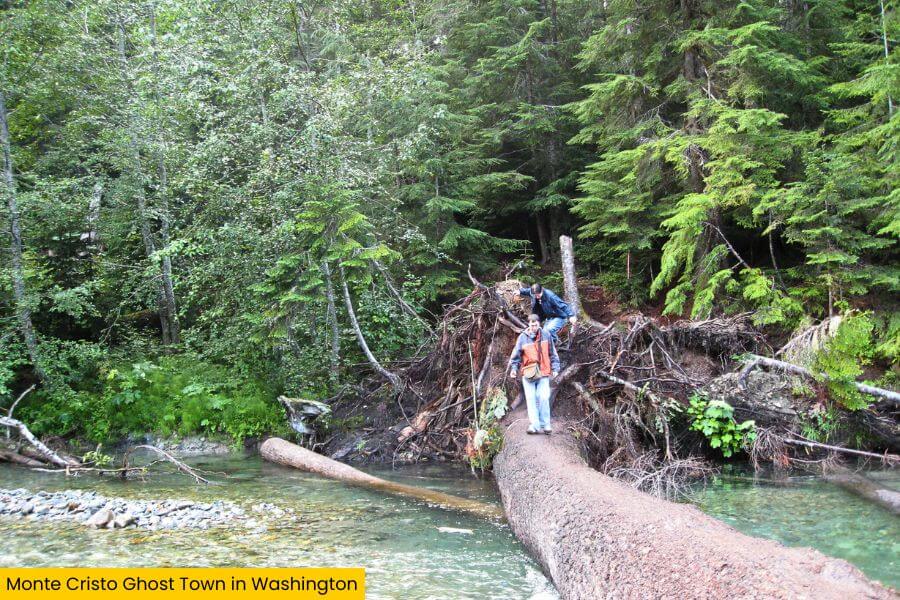
That said, don’t expect a smooth stroll. You’ll cross creeks on logs, dodge puddles, and hike through some seriously soggy sections.
Waterproof boots are a good idea, especially after it rains.
There’s a river crossing about halfway in where the old bridge washed out years ago.
Sometimes there’s a log or two to help you across, but in high water, it can be tricky. Always use caution here.
Once you reach the townsite, there are a few side trails to explore more of the ruins. Stick to the main paths and follow any posted signs.
A local group has worked hard to preserve what’s left, so don’t climb on structures or take souvenirs.
There are no restrooms past the parking lot, and no trash cans, so pack it in, pack it out.
Also, there’s no cell service out there. Download maps ahead of time, or bring a GPS device if you want to explore beyond the main trail.
Monte Cristo might not be the easiest spot to get to, but that’s part of what makes it so cool. It’s quiet, a little eerie, and totally worth the effort.
Related Posts