
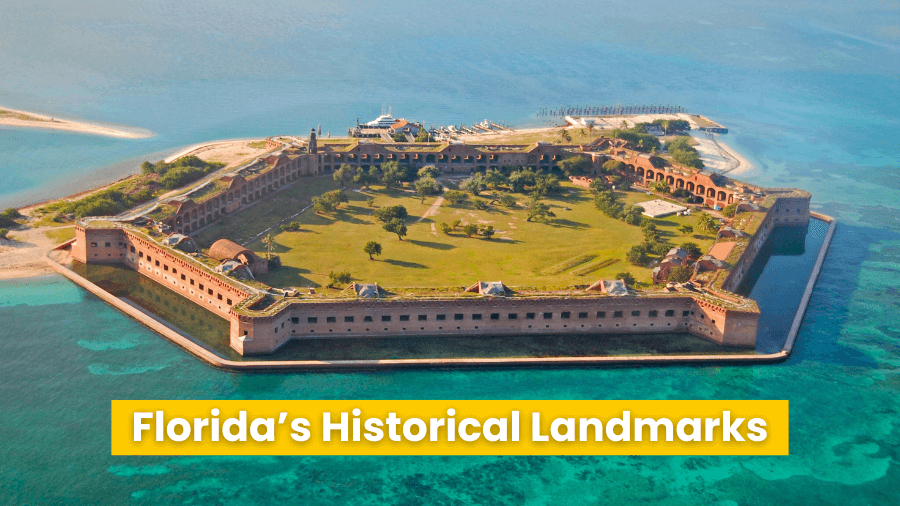
Sure, Florida is known for fun and sunshine, but its real surprises come from the wild, surprising, and totally fascinating history hiding in plain sight.
From ancient shell mounds to massive forts and even a hotel fit for royalty, this state has stories that go way beyond what you learned in school.

You can walk through homes from the 1800s, stand where famous explorers once landed, and even visit a place that was once a haven for people escaping slavery.
If you’re curious about the real Florida, shaped by Native peoples, colonizers, soldiers, and everyday folks, these are the places where the past comes to life.
1. Historic Pensacola Village
Colonial Era Crossroads, 16th–19th centuries

Historic Pensacola Village sits in the heart of downtown Pensacola, showcasing over 450 years of history dating back to the Spanish landing in 1559.
This 8.5-acre site features 30 historic buildings and museums, including the 1805 Lavalle House and the Museum of Commerce with an old-timey street scene.
To see it all, you can join a guided tour led by costumed staff who share stories from colonial times through to the Victorian era.
Bonus: You’re just a few minutes away from the Pensacola Bay waterfront, making it easy to grab lunch or explore more of Pensacola afterward.
2. Mission San Luis
Spanish Mission Era, 17th century

Next up is Mission San Luis in Tallahassee, a seriously cool place if you’re into living history.
It was a Spanish mission from the 1600s where settlers and the Apalachee people lived side by side, and now it’s been reconstructed for you to explore just as they once did.
There’s a giant thatched Franciscan church, a council house, and costumed interpreters demonstrating daily life and historic crafts.
It’s all outdoors and super interactive, so bring comfy shoes and get ready to step way back in time.
3. Kingsley Plantation
Antebellum South & African American History, early 19th century

Located on Fort George Island near Jacksonville, Kingsley Plantation tells one of Florida’s most powerful and complex stories.
Established in the late 1700s and active in the early 1800s, the plantation still stands with its main house, barn, kitchen, and the remains of 25 tabby slave cabins.
It’s named after Zephaniah Kingsley, who ran the place with his wife Anna (a formerly enslaved woman from West Africa), and their story is as captivating as the site.
Now it’s peaceful, surrounded by mossy oaks and quiet trails, but every corner makes you pause and remember the people who once lived and labored here.
4. Fort Mose Historic State Park
First Free Black Settlement, 18th century

In St. Augustine, Fort Mose Historic State Park shares the story of the first legally sanctioned free Black community in what is now the United States.
Back in 1738, this was a refuge for people who escaped slavery and journeyed south to Spanish Florida, where freedom came with a duty to defend the fort.
Today, there’s a small museum with powerful exhibits, boardwalks through the marsh, and a lookout marking where the fort once stood.
It’s a small park with a massive history, and standing here feels like being connected to something truly important.
5. Castillo de San Marcos National Monument
Spanish Colonial Defense, 17th century

Up next is Castillo de San Marcos National Monument in St. Augustine, the oldest masonry fort in the continental U.S., dating back to 1672.
The Spanish constructed this giant coquina stone fortress to protect Florida from pirates, British attacks, and other threats trying to take over.
When you visit, you can walk along the high stone walls, peek inside the old soldiers’ quarters, and even catch live cannon firings on some weekends.
It sits right on the Matanzas River, so the views are amazing, and the history hits hard once you realize this place has been standing strong for over 350 years.
6. Henry B. Plant Museum
Gilded Age Tourism Boom, late 19th century

If you’re craving a totally different side of the state’s history, the Henry B. Plant Museum in Tampa delivers major Gilded Age glam.
It’s inside the old Tampa Bay Hotel, a super fancy resort from the 1890s with onion-shaped domes, luxurious furniture, and enough art to make your jaw drop.
Henry B. Plant built this spot to draw wealthy visitors down south by train, and now it shows how Florida’s elite lived when electricity was still a novelty.
Every room here drips with Victorian charm and feels like stepping into a scene from an old movie.
7. De Soto National Memorial
Age of Exploration, 16th century

For a peek at the state’s earliest European contact, swing by De Soto National Memorial in Bradenton, where Hernando de Soto and his crew landed in 1539.
This place honors the start of a brutal expedition through the Southeast, and today it’s a peaceful park with trails, living history programs, and Manatee River views.
There’s also a visitor center with armor and artifacts, plus reenactments that bring to life the experiences of the explorers and the Native peoples they met.
It’s a chill place to walk, picnic, and learn, but it also digs into the complicated story behind one of the first major European arrivals in Florida.
8. Calusa Heritage Trail
Pre-Columbian Indigenous Civilization, 500–1700 CE

Down on Pine Island, the Calusa Heritage Trail takes you deep into the world of the Calusa people, who ruled southwest Florida long before the Spanish arrived.
This quiet and shady 0.7-mile trail winds through massive shell mounds and canals built by the Calusa roughly a thousand years ago.
You’ll see signs and exhibits that explain how they fished, traded, and ran their kingdom without ever needing agriculture.
As part of the Randell Research Center, it’s a living archaeological site where experts still dig up clues about this very advanced society.
9. Fort Jefferson
Civil War Coastal Defense, mid-19th century

And if you’re up for a real adventure, Fort Jefferson in Dry Tortugas National Park offers Florida history surrounded by tropical beauty.
It’s a massive brick fortress built in the 1800s on a tiny island 70 miles west of Key West, and you can only reach it by boat or seaplane.
The fort was never finished, but it still became a Civil War prison that once held Dr. Samuel Mudd, who was implicated in President Lincoln’s assassination plot.
Between exploring the old cells and snorkeling in the crystal-clear water, this place feels both like a history class and an island getaway.
Related Posts

