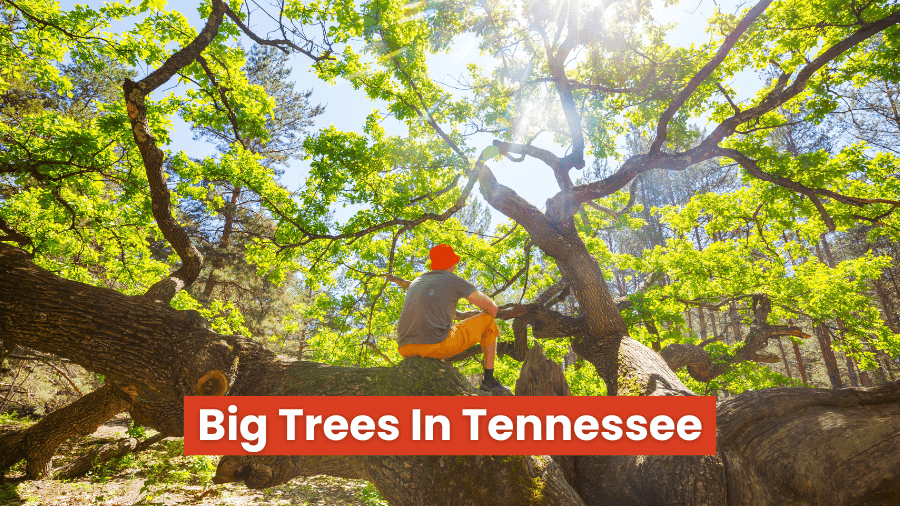
Some trees are nice to look at, but others will make you stop in your tracks and wonder how they got so big.
In Tennessee, you’ll find some of the tallest, thickest, and oldest trees in the Southeast, and they’re hiding in all kinds of places you might not expect.

We’re talking giants so big you can’t wrap your arms around them, trunks older than the United States, and canopies so high they seem to disappear into the clouds.
From shady trails and swampy boardwalks to city sidewalks, these leafy giants are out there, just waiting for you to discover them.
1. Albright Grove, Great Smoky Mountains National Park
Albright Grove sits along the Maddron Bald Trail in the Great Smoky Mountains National Park, and it’s one of the park’s last untouched old-growth forests.
Here you’ll walk among massive tulip poplars towering over 135 feet, plus giant eastern hemlocks and Fraser magnolias with super wide trunks.
Some of these trees are over 200 years old, and the trail takes you deep into this living skyscraper forest.
It’s the kind of place where you’ll probably spend more time looking up than walking forward.
2. Joyce Kilmer Memorial Forest

In Nantahala National Forest, the Joyce Kilmer Memorial Forest is like stepping into a land where trees have had centuries to show off.
Following the main loop trail which forms a figure of eight, you’ll pass colossal tulip poplars that can hit 100 feet tall, along with red oaks and American beeches.
Many of these giants are 400+ years old, with bark so thick and gnarled it feels like running your hand over a stone wall.
It’s quieter here than in the Smokies, the kind of silence where you can hear every crunch of leaves.
3. Ramsey Cascades Trail, Great Smoky Mountains National Park
Back in the Smokies, the Ramsey Cascades Trail serves up giant trees and ends with the park’s tallest waterfall.
This 8-mile round-trip climbs past tulip poplars, basswoods, and silverbells that hit over 120 feet, some with trunks far too wide to wrap your arms around.
Along the way, you’ll walk through a hardwood forest with a canopy so dense it feels like a green cathedral overhead.
By the time you reach the 105-foot-tall Ramsey Cascades, you’ll have experienced both the park’s grandest trees and its most dramatic waterfall in one trip.
4. Big Cypress Tree State Park

Over in Weakley County, Big Cypress Tree State Park proves you don’t need mountains to find record-setting trees.
The park was named after a legendary bald cypress that once stood 175 feet tall and 40 feet around.
It was one of the largest of its kind in the U.S. until lightning took it down in 1976.
Today, you can wander a short boardwalk through a swampy landscape where cypress and water tupelo stretch toward the sky.
It’s a quick, easy walk, but the sheer size of these swamp giants will have you craning your neck the entire time.
5. Cucumber Gap Trail, Great Smoky Mountains National Park
Now we have Cucumber Gap Trail, a shady, peaceful hike in the Great Smoky Mountains that features a ton of history as well as big trees.
This 5.6-mile loop winds past yellow buckeye and tulip poplar trees that rise far above the trail.
You’ll also spot moss-covered stone chimneys and foundations from the early 1900s logging and resort days.
It’s the kind of trail where you can slow down, listen to the Little River flowing nearby, and realize just how tall these giants really are.
6. Vanderbilt University Arboretum

Set in Nashville, the Vanderbilt University Arboretum packs a surprising number of massive trees into its 330-acre campus.
You can stroll shaded sidewalks under century-old magnolias, American elms, and oaks that easily top 100 feet, each tagged so you can learn their names.
Some of the biggest stand right on the main lawn, where their sprawling branches create natural green umbrellas perfect for a picnic or a study break.
It’s a tree lover’s dream without ever having to lace up hiking boots or leave the city.
7. Savage Gulf State Natural Area

Up next is Savage Gulf State Natural Area in Beersheba Springs, which takes our big tree adventure to the sandstone canyons of the Cumberland Plateau.
Here, trails like the Collins Gulf loop lead you past super tall yellow poplars and pines.
Some of the tallest hardwoods grow right along the streams, where their trunks rise like columns between waterfalls and rocky cliffs.
It’s a wilder, more remote setting, and every large tree you see reminds you how far you are from the crowds.
8. Big South Fork National River & Recreation Area

Lastly, Big South Fork National River & Recreation Area straddles the Tennessee–Kentucky line with towering trees, sandstone arches, and river views.
On the 2.8-mile Angel Falls Overlook Trail or Leatherwood Loop, you’ll see tulip poplars, sycamores, and hemlocks soaring overhead.

The mix of massive trunks and rugged cliffs makes the forest seem theatrical, with the trees acting like grand stage props for the rushing Big South Fork River.
It’s a place where the height of the trees matches the beauty of the sweeping canyon panoramas.
Related Posts